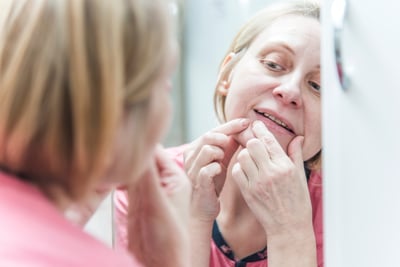
There’s an app for everything these days—even your skin!
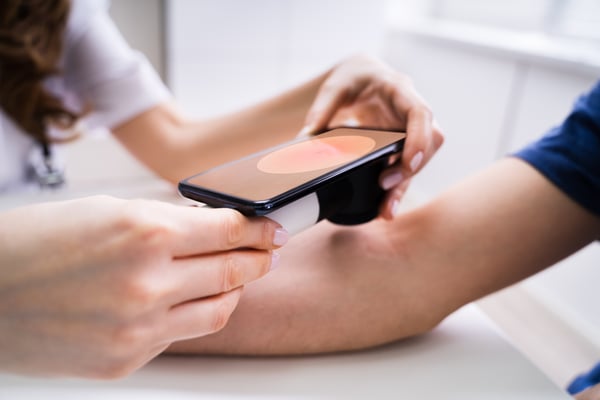
In just a few seconds, an AI-powered app can analyze a photo of a rash, breakout, or even the condition of your skin and offer instant feedback about the best treatments. For many people, that can feel like a fun, futuristic way to learn more about their skin. And in some cases, it’s a good first step toward noticing changes that deserve attention.
If these apps can bring greater attention to skin health and skin care, that’s great. But given their limitations, such apps work best when paired with actual medical expertise from a board-certified dermatologist. The best apps work this directly into their systems for accurate and ethical diagnosis.
So how do these AI skin apps work, and when should a professional dermatologist step in?
How AI skin apps work
The rise of AI-powered skin-analysis apps taps into our desire for instant answers, offering everything from advice for dealing with dry skin and fine lines to diagnoses concerning conditions like rashes or lesions.
These apps use high-resolution photos of your skin, taken with your device’s camera, and analyze them with image recognition or machine learning technology. The AI draws on extensive libraries of labeled skin condition images to compare your photo against known examples, identifying patterns and generating a “most likely” match or risk assessment.
In research parlance, these apps often involve a convolutional neural network (CNN) or other deep-learning model designed to recognize patterns in images by automatically detecting features like edges, colors, and textures, and using them to classify the image into categories. Some apps then take the extra step of allowing users to connect with a doctor to review the images and see if further tests are necessary.
Studies have shown that using CNN to evaluate skin conditions can be as accurate as a doctor’s diagnosis. For example, a recent systematic review found AI algorithms were able to detect skin cancer at rates comparable to expert-level dermatologists in selected settings. Considering that skin cancer is the most common type of cancer and will affect 1 in 5 Americans by age 70, AI represents an important addition to skin health technology for increasing early detection.
AI in the lab vs. on your phone
Though AI can perform impressively in clinical research, there are important caveats for users at home. First, the results provided in those studies named above used AI in combination with diagnosis by trained dermatologists. Furthermore, the conditions were extremely controlled (well-lit images, curated data, single lesion types, trained personnel) and do not reflect the everyday scenario of the average user snapping a photo at home and analyzing it with a commercial app.
When AI skin tools are used in everyday circumstances by consumers, there can be complications—which means that it is hard to draw conclusions without the guidance of a board-certified dermatologist.
Issues with skin diagnosis app accuracy
Though AI can be an important tool for assisting dermatologists, limitations of skin apps for your phone include:
- Image quality and variability: A photo taken with a smartphone can be affected by lighting, focus, angle, shadow, skin tone, background, and camera model. These factors can vary wildly and greatly reduce accuracy.
- Dataset bias and skin tone issues: Many AI models have been trained on images that under-represent darker skin tones or less common types of skin problems. Studies show that performance drops on images of dark-skinned individuals or rare conditions.
- “Most likely” isn’t definitive: Algorithms often give a probability or top-predicted diagnosis, but they cannot perform the full exam. An app cannot feel the texture of skin, see subtle context, evaluate surrounding skin history, or know your medications or past skin history.
- Lack of regulation and oversight: Consumer apps are often not held to the same regulatory and legal standards as medical professionals.
- Business incentives: Most app business models depend on high usage and engagement rather than outcome, which may conflict with what is best for patient safety.
In one study, an AI skin app included the real diagnosis in its top five guesses only about half the time, and gave the correct diagnosis just 23% of the time. So, the app was right occasionally, but often its main answer (and sometimes even its top five) missed the true diagnosis. Such an app might say, for example, that a spot is “probably acne” when it’s actually something different, or even something serious.
The risks:
- A false reassurance (the app says “low risk,” so you delay seeing a dermatologist).
- A false alarm (the app flags “high risk,” causing anxiety).
- Misinterpretation of results (a user might think the app is making a medical diagnosis rather than offering a rough screening).
A scoping review pointed out that most currently available AI dermatology apps have critical gaps when it comes to effectiveness and safety.
Dermatologist vs. AI: Why professional diagnosis still matters
Putting aside the hype, let’s talk about what a board-certified dermatologist brings to the table and why that matters so much.
- Full clinical context: A qualified dermatologist takes your full medical history, examines your skin concern in person, assesses your risk factors (family history, previous skin cancers, immunosuppression, skin type, sun exposure history) and examines surrounding and other skin areas.
- Tactile, visual, and diagnostic tools: Many concerning spots require palpation, dermoscopic evaluation, possible biopsy, or other imaging. A smartphone photo cannot replace a hands-on exam.
- Continuity of care and ethical obligation: Dermatologists are licensed, participate in continuing education, abide by ethical and legal standards, and have a duty of care. This means if something is missed, there are mechanisms for oversight and recourse. An app, in contrast, often comes with a “non-medical” or “for education only” disclaimer.
- Treatment and follow-up: If something is diagnosed, your dermatologist oversees treatment and monitors results, follow-up visits, and escalation as needed.
- Regulated oversight and accountability: Physicians are subject to boards, liability, peer review. In contrast, the world of iPhone and Android apps lacks consistent regulation.
It’s worth noting that, unlike medical providers, many apps also profit from user data. Your photos, skin details, and even your location may be stored, sold, or used to train future algorithms. That’s very different from the privacy protections you have in a medical office.
Where skin apps can be helpful
To be clear: We’re not dismissing new technology. First, the role of AI for assisting diagnosis by trained clinicians is incredibly promising. Forefront itself is looking into using this technology, in very specific domains, to provide a better experience for its patients.
This is because AI skin apps can provide some benefits, when deployed appropriately. They can, for example, offer product recommendations or skin care regimens to address cosmetic concerns. They may also help raise awareness by prompting users to get a new spot checked, assist with tracking changes in known benign moles, or even help triage patients in areas where access to dermatologists is limited. What they cannot do is replace actual professional diagnosis.
Think of an AI skin app like a weather app: Useful for a quick check, but you wouldn’t rely on it for structural engineering decisions in a storm.
Your skin deserves expert care
At Forefront, our board-certified providers combine advanced diagnostic technology with years of clinical expertise to give you answers you can trust.
If you notice a spot, rash or skin change that concerns you, the safest, smartest thing is to schedule a dermatology appointment. Because when it comes to your skin, “probably fine” from an app is not the same as “cleared by a dermatologist.”
Get started now by finding a Forefront location near you.
Related Articles AI skin app - dermatologist vs AI - skin cancer diagnosis - skin diagnosis app accuracy - skin health technology -
GLP-1 Drugs Need Proper Medical Monitoring for Safe and Effective Use
Healthy Food Choices for Healthy Skin

Aging, Region by Region: How Different Areas of Your Skin Tells Different Stories

How Air Quality Impacts Your Skin More Than You Think—And What to Do About It
Breaking the Flare Cycle: How Modern Eczema Care Supports Your Skin’s Ecosystem